
'Who is the right Mekhail? Mekhail I or Mekhail II?'

Mekhail hopped off the bench in a hurry and turning his back to Indrani, stood at the window. Indrani ignored him too. Mekhail is getting married later this year. His mother will, of course, not be in attendance. Nor, of course, would he want her to be there, if she could.

'The three tycoons I deal with in the first chapter -- Ambani, Mallya and Adani -- in their own way represent the change that has come over India.' 'Of the three of them, Mallya is the most fun. He was terrific.' 'And I don't say that because I tell the story in the book of his golden toilet.'

Pasbola wound up his cross examination, tabling a new narrative in the murder case. That Sheena Bora had been murdered not by her mother. But by her brother.

And then came the chief moment of Friday. If the courtroom had a soundtrack, Beethoven's 9th would be playing, providing a triumphant, dramatic prologue to the production of this last clip. A woman reporter was asking Mekhail about Sanjeev Khanna. He says clearly, without mincing words, emphatically: 'Never seen him. First time I am hearing his name.'

'If India maintains the Constitutional set-up that its founders envisaged -- which is that it is a parliamentary democracy, with a broadly speaking market economy, in which all people are equal as everyone votes, in which the rights of minorities are respected -- that will be a great thing.' 'Not just for India. But for humanity.'

Mekhail delivered the most deliberate heart-tugging line of the day: "If a son asks his mother for money is wrong, then tell me." At the back Indrani gave one of her most beaming smiles that was meant to convey the exact opposite. This was no mother happy that her son had said he turned to her when he needed money because she was his mother.
Vaihayasi Pande Daniel reports from the Sheena Bora murder trial.

'Most likely scenario is Modi comes back with either a much smaller majority and no majority at all and a coalition.' 'Very hard to imagine him doing better than he did last time.' 'He will then be a weaker prime minister,' the author of The Billionaire Raj tells Rediff.com's Vaihayasi Pande Daniel.

It is not often that Goswami's Nation-Wants-to-Know shows become material evidence in a murder trial no less. Nor was it something CBI Special Judge J C Jagdale was wildly enthused about. It had to be done because as he put it to CBI Special Public Prosecutor Kavita Patil caustically: "Your witnesses gave interviews to channels about a serious crime."

The question being silently telegraphed around the court room was: When did this happen? Wasn't this trial about Indrani murdering her daughter to prevent her from marrying Rahul Mukerjea, her husband Peter Mukerjea's son from his first marriage?

After the wedding, Sheena and Mekhail did not meet again. Four or five months later she met her death. Mekhail referred to their last meeting without overt emotion, clear-eyed.
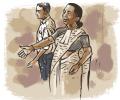
Ever since Mekhail had first entered the courtroom, he had, it would seem, never once looked at his mother, though they were a few metres away from each other. Curiosity, residual regard, memories, anger, none of it, could make him even look at the woman who gave birth to him. Was his hatred so overpowering?

One couldn't help feeling a certain melancholy viewing these now vagrant documents and photographs that would never be rightfully cherished. The pictures spoke to you. They offered slices of extinguished lives. They breathed sadness too, for what could have been and will never be. The sweet promises that Life made and insolently, arrogantly never kept.

The ripping off the lid, that Mekhail did, on the chain of episodes that lead up to his sister's murder, while condemning Indrani for her actions, for the first time, paradoxically, allowed a more human -- if flawed and complicated -- picture to emerge of Indrani, allegedly The Woman Who Killed Her Own Daughter and shocked a nation.

Throughout, Mekhail spoke calmly, with hardly an inflection making even the barest attempt to hijack his tone. His tone was so empty it made his narrative all the more touching. And ugly and grey, as the monsoon sky beyond the window.

'It is vital that objects such as the Harihara -- and collections from South Asia generally -- remain here,' the British Museum tells Vaihayasi Pande Daniel.

'Does a thousand-year-old sculpture worshipped in a thriving religion belong to a foreign museum or the temple from which it was extracted?' Congress MP Shashi Tharoor asked angrily. 'They legitimately belonged to India and people of past, present and future generations are interested in re-possessing them,' a central information commissioner declared last month.

Shashi Tharoor says the British Museum should change its name to Chor Bazaar because whatever it has within its portals is the result of 200 years of theft. The museum is once again in the eye of a storm for the possession of a statue of a god Hindus, across the world, worship as the Supreme Being.

One always ponders over why the witnesses should not have poor memory when answering cross examination questions or recounting events that occurred six years ago. Too many witnesses seemed to have drunk some Harry Potter-esque Philosopher's Stone magic elixir that has Botoxed their fading memory to make it as good as new again.

After ten minutes no one could keep track of the legal team's questions on the geography of the route Sandeep Patil took on his Pulsar Bajaj motorcycle, on the morning of April 25, 2012. Not the judge. Or the onlookers. Least of all Patil.
 © 2026 Rediff.com - Investor Information - Advertise with us - Disclaimer - Privacy Policy - Sitemap - Feedback - About us - Terms of use - Grievances